
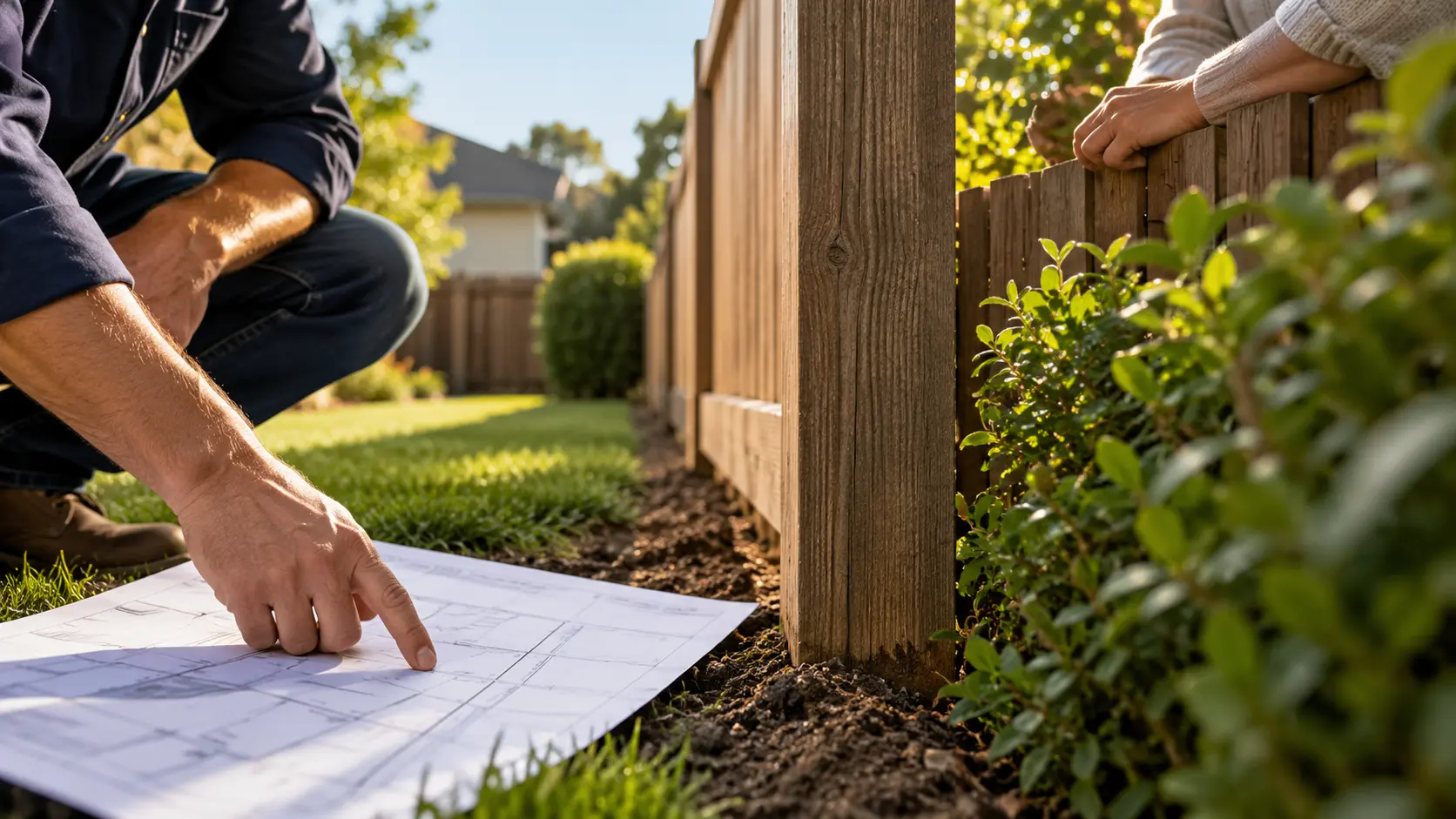
If a fence separates your yard from your neighbor’s property, it may seem like determining ownership should be simple. In reality, you usually can’t tell whose fence is whose just by looking at which side has the posts or which yard gets the finished side.
A better starting point is the property boundary, the location of the fence in relation to that boundary, and any property information already available to you.
This distinction matters if you’re considering repairing, replacing, or removing an existing fence. Before making changes, it’s worth understanding what the available evidence actually tells you—and what it doesn’t.
Start With the Property Line and Available Records
The first step is to understand where your property ends and the neighboring property begins.
Don’t assume an existing fence marks the exact property line. A fence may have been installed slightly inside one property, and an older fence may have been built long before either current homeowner purchased the property.
Start by reviewing information you already have, such as:
- An existing property survey
- Documents from the purchase of your home
- Available parcel or property records
- Information showing property dimensions or boundaries
For Lexington properties, the Fayette County Property Valuation Administrator provides parcel and property information that can be useful when researching a property.
However, reviewing a parcel map or property record isn’t necessarily the same as establishing a precise legal boundary. If the exact property line needs to be determined before construction or because of a disagreement, a qualified land surveyor may be appropriate.
Once you have a better understanding of the boundary, you can determine where the existing fence sits in relation to it.
Can You Tell Whose Fence It Is by Looking at the Posts?
Fence construction may provide clues about who originally installed a fence, but appearance alone isn’t reliable proof of ownership.
Some fences are traditionally installed with the posts and structural components facing the property where the fence was built, leaving the more finished side facing outward.
But that isn’t something you should rely on by itself.
The original installer may have chosen a different orientation. A previous homeowner may have installed the fence. The fence may have been repaired or altered over the years, and some modern fence styles look nearly identical from both sides.
The location of the fence in relation to the property boundary is therefore more useful than simply asking which direction the posts face.
Think of the posts or finished side as clues—not proof of ownership.
Is the Fence on the Left or Right Side Automatically Yours?
Another common assumption is that homeowners automatically own or maintain the fence on a particular side of their property.
There isn’t a universal left-side or right-side rule you should rely on to determine who owns a particular fence.
Neighborhood traditions may develop over time, but they don’t establish where the property boundary is or prove who owns an existing structure.
Instead of relying on which side of the yard the fence is on, go back to the property information and the actual location of the fence.
Talk to Your Neighbor Before Making Changes
If ownership isn’t immediately clear, your neighbor may have useful information about the fence’s history.
They may know who installed it, approximately when it was built, whether previous owners discussed the boundary, or who has historically handled repairs.
That information isn’t a substitute for a survey when the precise boundary needs to be established, but it can provide helpful context.
A conversation is especially worthwhile before removing, replacing, or substantially modifying a fence near a shared property line.
Discussing the project beforehand gives both property owners an opportunity to clarify concerns and can prevent a simple fence project from turning into an unnecessary disagreement.
Understand the Difference Between the Property Line, Fence Ownership, and Maintenance
Fence questions become confusing because several different issues are often treated as though they’re the same.
Where is the property line?
This identifies the boundary between neighboring properties.
Who owns the existing fence?
This concerns the physical structure that has been installed.
Who is responsible for repairing or replacing it?
This concerns maintenance or changes to that structure.
Finding the answer to one question doesn’t necessarily answer all three.
For example, identifying the property boundary can help determine where an existing fence is located, but it may not explain who originally installed an older fence or what agreements previous property owners may have made.
Keeping these questions separate helps you identify what information you still need before taking action.
What If You Still Can’t Determine Whose Fence It Is?
If you’ve reviewed the available information and talked with your neighbor but the situation remains unclear, the next step depends on what you’re actually trying to determine.
If you’re uncertain about the property boundary, consider consulting a qualified land surveyor.
If the issue involves ownership rights, responsibility, or an active disagreement between property owners, appropriate property or legal guidance may be needed.
If the boundary and ownership questions are already resolved and you simply need to determine whether the fence can be repaired or should be replaced, a fencing professional can evaluate the condition of the structure and discuss practical options.
Using the appropriate professional for each question can help prevent assumptions from creating bigger problems later.
Before Repairing or Replacing the Fence
Once the boundary and any ownership concerns are clear, you can focus on the condition of the fence itself.
Look at the overall structure rather than judging it by a single damaged panel.
Consider whether:
- Fence posts remain stable
- Panels, pickets, or rails are deteriorating
- Gates still open, close, and latch properly
- Sections are leaning or repeatedly needing repair
- Damage is isolated or spread throughout the fence
- The existing fence still meets your privacy, security, pet, or property needs
A localized problem may be repairable. When deterioration affects much of the structure, replacement may become the more practical option.
At this stage, a fencing contractor can evaluate the existing fence, explain repair or replacement possibilities, and help you understand the scope of the project.
Planning Fence Work in Lexington, KY
If you’re planning a fence project in Lexington, it’s also important to check current local requirements before construction begins.
The City of Lexington provides homeowner guidance for fences and walls through its building inspection resources. Requirements can vary depending on the property, location, and proposed work, so it’s better to verify what applies to your project rather than assume the rules are the same everywhere.
Property boundaries deserve particular attention before a new fence is installed. Confirming the location first can help avoid placing a new structure where it shouldn’t be.
This is another reason to resolve boundary questions before choosing materials, scheduling installation, or removing an existing fence.
Know When the Project Is Ready for a Fence Professional
A fencing contractor can help with the fence, but shouldn’t be expected to establish a legal property boundary.
Once boundary and ownership questions have been addressed, a professional fence contractor can help evaluate an existing fence, compare repair and replacement options, select appropriate materials, and plan the installation itself.
If you’re preparing for a fence project in Lexington, KY, Lexington Premiere Fencing can help you evaluate the fencing options that fit your property and project goals.
The important part is getting the steps in the right order.
If you don’t know whose fence is whose, don’t rely solely on the posts, finished side, or which side of the yard the fence happens to be on. Start with the property boundary and available records, communicate with your neighbor when appropriate, and get the right professional involved when additional clarification is needed.
Once those questions are settled, you can move forward with the fence itself with much greater confidence.